
SWICO - AI in Action
Knowledge Management
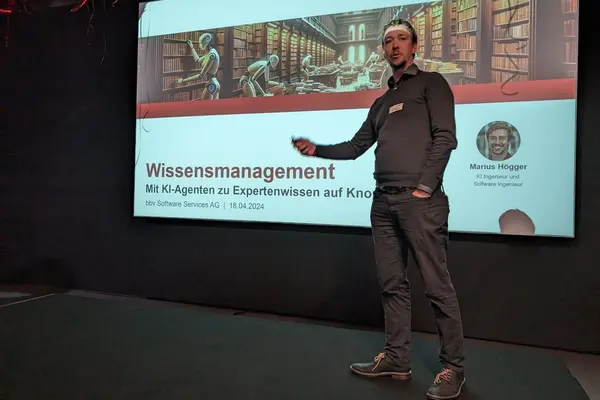
On 19 April 2024 I, Marius Högger (AI Engineer at bbv), had the opportunity to give a talk on "Knowledge Management with AI Agents" at the industry association Swico's "AI in Action" event series. The event took place in a remarkable setting at Luma Westbau in Zurich, where floor-to-ceiling bookshelves and art installations created an inspiring environment for the exchange of knowledge.
Right from the start it was clear: Swico wanted not only to give participants theoretical background knowledge but to show them through concrete examples and practical insights how AI can be used effectively. Together with two other speakers, I was at the centre of a lively exchange that illuminated both the fascination and the challenges of artificial intelligence.
The SWICO AI Event Series "AI in Action"
The SWICO AI event series is designed to familiarise members and interested parties with current trends and developments in the field of artificial intelligence. Under the motto "AI in Action", participants on 19 April 2024 were able to follow engaging talks covering the following topics:
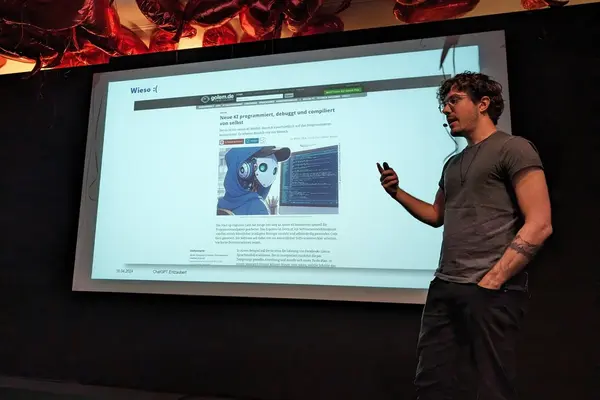
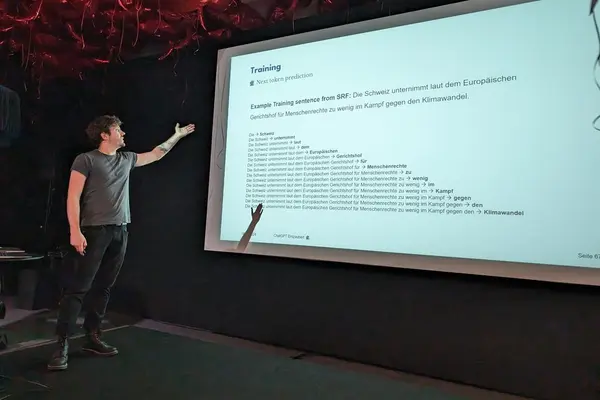
- "ChatGPT Demystified" - presented by Joel Barmettler (Senior AI Engineer at bbv and Universität Zürich), who used machine learning fundamentals and concrete examples to show how Large Language Models (LLMs) like ChatGPT work and where their limits lie.
- "Knowledge Management with AI Agents" - my talk, in which I presented a proof of concept for the practical use of AI agents in an organisation. The focus was on how employees gain access to relevant expert knowledge through AI-supported systems without getting lost in floods of data.
- "Strategies for Transforming Ideas into AI-Powered Products" - delivered by my colleague Dr. Emre Özyurt (AI Consultant at bbv), who presented methods and approaches for turning early ideas into viable AI products.
The goal of the event was to bridge theory and practice and show how AI creates value across different business areas.

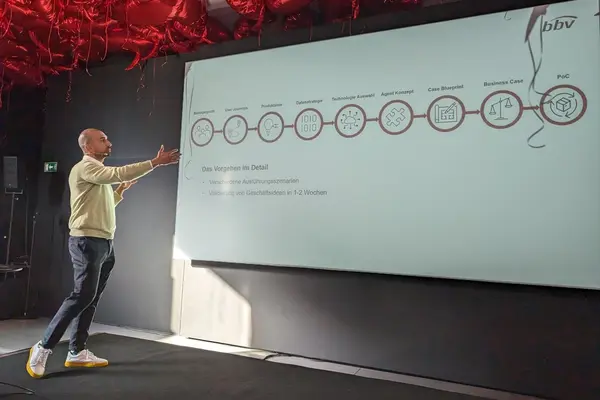
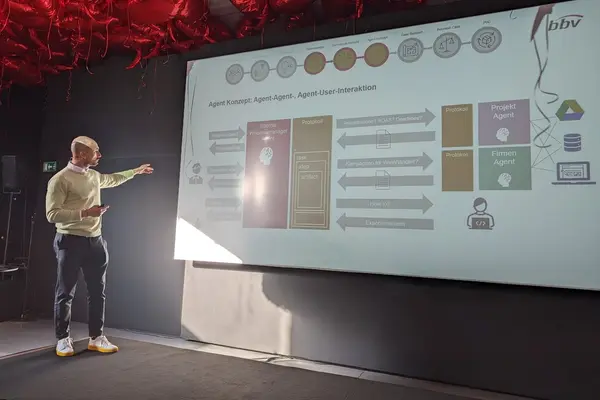
My Talk: "Knowledge Management with AI Agents"
In my presentation I asked how we can better navigate the ubiquitous "knowledge labyrinth" in organisations with the help of AI agents. Important information is often scattered across different departments, databases and documents, which means a time-consuming search, especially for new employees.
Context Is the Key
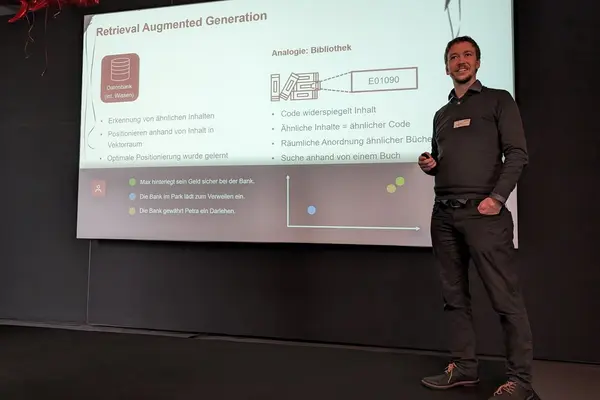
A core element of my presentation was the importance of context. Classic chatbots like ChatGPT are based on statistical language models and excel at processing natural language. However, their factual accuracy is not always guaranteed, since they frequently only predict the most probable next word without necessarily drawing on real data from the company environment. To address this problem, I relied on the principle of Retrieval Augmented Generation (RAG).
With RAG, external company-specific data sources are dynamically incorporated into the response process. This means the AI, rather than relying solely on its training, retrieves relevant documents from a knowledge database and extracts concrete information from them. This step substantially improves the quality of answers and ensures that the AI system understands the company context and delivers fact-based results when needed.
AI Agents as Virtual Employees
A further focus was on the concept of AI agents. Unlike pure chatbots, agents have a defined "role" and "task"; they act like virtual employees who not only answer questions but actively absorb expert knowledge from real employees and make it available again in real time. I explained how such agents can be configured using role profiles and "character traits" (for example tone, area of expertise, responsibility) so that they respond precisely to the problem at hand.
Proof of Concept: Value in Practice
To make my explanations tangible, I presented a proof of concept in which an AI agent supports newly hired employees during onboarding. Instead of laboriously working through countless documents, they receive direct access to relevant process documents, checklists and contact persons via a simple chat interface. The agent learns continuously from employee inputs, stores new insights and makes them automatically available the next time they are needed.
The Fire Alarm: An Unplanned Break
During my talk something happened that literally "heated up" the evening: while preparing the aperitif in the adjacent room, something apparently caught fire, triggering an unplanned fire alarm. Suddenly loud sirens sounded and we had to vacate the event hall in a hurry.
What initially caused a little disruption turned out in hindsight to be a welcome opportunity to let the material sink in. Some participants used the brief enforced pause to discuss possible AI use cases in their own companies outside. After a few minutes the all-clear was given and we were able to continue the presentation and the rest of the event without further incident.
Discussions and Outlook
In the subsequent discussion round many of those present still had open questions on data protection, permissions and bias. Topics included how much access an AI agent should have to confidential company information and how to ensure that no unwanted data leaks occur. I pointed out the possibility of controlling access rights at a granular level and only "feeding" agents with the information they actually need for their task.
The risk of manipulation and bias was also an important topic: since language models depend heavily on the available data, one-sided or incomplete datasets can easily lead to distortions (biases) in the AI's responses. This is precisely where measures such as controlled data management, careful prompt engineering and continuous monitoring and updating of models come in.
Beyond the technical challenges, there is always the question of how to finance such a project, justify it to management and integrate it into existing organisational structures in the long term. Here my colleague Dr. Emre Özyurt highlighted in his talk that it is often advisable to start with a pilot project in a limited knowledge area. Once the results are convincing, further knowledge domains can be opened up step by step.
Conclusion: AI Agents in the Enterprise
The response to my presentation at the Swico AI event series was consistently positive. Participants saw great potential in using AI agents in their own companies to optimise knowledge management and relieve employees of recurring research tasks. Despite occasional concerns around data protection and costs, many agreed that a well-conceived and tightly monitored AI system delivers enormous advantages in the long run.
Knowledge agents have the potential to revolutionise access to company knowledge: they act proactively, learn continuously and create a dynamic, living knowledge network. For companies operating in a highly competitive environment, this can be a decisive competitive advantage.
Overall the event, unplanned fire alarm included, was a complete success: it conveyed a solid understanding of current AI technologies and a clear picture of how they can be transferred effectively into business practice. For me personally it was an exciting opportunity to present my proof of concept to an interested specialist audience and receive valuable feedback. I am convinced that we will see further rapid advances in the coming years and look forward to continuing this journey together with the Swico community and interested organisations.
Links
- AI in Action: Transformation of Knowledge Management through Artificial Intelligence, on SWICO.ch.
- Smoking heads and kitchens at Swico from Netzwoche.